
The Methodist Church
THE STORY OF THE METHODIST CHURCH
STANFORD-LE-HOPE
By F.G. Beard
“We love the place, O God,
Wherein Thine honour dwells;
The joy of Thine abode
All earthy joy excels.”
Preface
Just as the source of a river may be traced to a small spring, so the writer of this little volume has traced the “river” of Stanford-le-Hope Methodism back to its humble and lowly origin.
In simple and terse language, the writer shows us the earnest faith of the pioneers and the vision given to them by God. The little handful of people in the humble thatched cottage started a work for God destined to bless thousands of people.
Like John Wesley, we too can say: “What hath God wrought!”
May this story encourage and inspire others whom God is calling into His service.
December 1945
G. H. Morris
SOME EARLY NONCONFORMISTS
Before Wesley
To write a complete story on such a subject would demand and deserve far greater space than is available here. It is, however, fitting that this short review of the Methodist cause at Stanford-le-Hope should open with a résumé of events prior to the last century.
It is said that “the prominence of Essex in the annals of Evangelical Nonconformity is second to that of no other county in the Kingdom,” and of that we may be justly proud. At this stage, however, it is worth turning to the history of our country to understand something of the early growth of the Nonconformist movement.
During the fourteenth century, Wyclif preached against the abuses of the Church of that day. His teaching was carried on by his followers, who were known as Lollards on account of their ardent hymn-singing — lollen, meaning “to sing”. It must be made quite clear that the Church of that day was under the authority of the Pope in Rome.
Among the Lollards were certain priests of the Church who spoke from their pulpits against the injustice of laws that imposed heavy taxation on the poorer classes. These laws had followed the Black Death, which, in 1348, had taken a devastating toll on life in this country. Conditions were so poor that there were not enough labourers to till the land.
In Essex, John Ball, a priest of Colchester, and Jack Straw, a priest of Fobbing, openly condemned such conditions and the burden of heavy taxation. John Ball prophesied that:
“Things will never go well in England so long as goods be not in common, and so long as there be villeins and gentlemen.”
Conditions did not improve and, in 1381, the villagers of Stanford-le-Hope, Corringham and Fobbing resisted taxation. There followed a rising of the Essex people, together with Kentish sympathisers, under the leadership of Wat Tyler. As a consequence, Wat Tyler was killed, and John Ball, who is thought to have been the first Wyclifist martyr, was executed at St Albans on 15 July 1381.
Henry IV, in order to secure the support of the clergy, passed a law in 1401 by which persons accused of heresy could be tried by the bishop and burned to death by the sheriff. As a result, the Lollards, who had supported the recent risings, were persecuted, and many suffered death. In spite of such treatment, however, their numbers continued to increase.
As previously indicated, the Established Church at this time was under Papal authority, and its services were conducted with great ceremony. Among the charges made by the Church against the Lollards, or so-called “heretics” of the day, were the following beliefs:
- That every believer in Christ Jesus is a priest of the chosen Church of God.
- That the matter of the bread is not destroyed in the Eucharist and converted into the body of Christ, but that it is sufficient for the faithful to believe that it is the body of Christ in remembrance, while remaining real bread in nature.
- That any believer might freely preach the Word of God, even though they had not been sent or licensed by the ordinary.
It is interesting to note that the blessing of the bread and wine, and the full significance of attendance at the Lord’s Table, remains a subject of considerable discussion even in our own day.
It is not surprising to find that executions on charges of heresy were frequent. Thomas Higbed of Horndon-on-the-Hill was betrayed to Bishop Bonner and burned at Horndon in 1555. In the same year, William Hunter, aged nineteen, was burned at Brentwood.
Among ten people from Essex who were similarly charged in 1556 was Henry Wye, a brewer of Stanford-le-Hope. During Mary’s reign, from 1553 to 1558, it is recorded that at least seventy-two martyrs were burned at the stake in Essex, chiefly at Colchester, Stratford and Brentwood.
During the reign of Elizabeth I, from 1558 to 1603, the teachings of Luther and Calvin became increasingly influential in this country. During this period of the Reformation, the new Protestant Church of England was established, and those devoted to the Roman Catholic system withdrew to the Roman Catholic Church.
Many of Wyclif’s followers, who had fled the country during Mary’s reign, now returned. However, they were strongly opposed to anything in the form and order of the new Protestant Church that reminded them of the Roman Church. They aimed for a purer form of worship and became known as Puritans.
They absented themselves from parish churches and held meetings in the homes of their followers. Many clergy adopted Puritan views, and by the Act of Uniformity in 1559, they were deprived of their livings. Their followers became known as Nonconformists.
Prior to this time, nonconformity had meant opposition to the Church of Rome. From this point forward, however, the term represented those who were opposed to the English Church.
Persecution of the Nonconformists continued, and early in the seventeenth century many sailed to the New England settlement in America. By the Toleration Act of 1689, Nonconformists were granted religious liberty. This period marks the beginning of the great progress made by Nonconformity during the last two and a half centuries.
John Wesley
John Wesley was born in 1703. While a young curate, he and his brother Charles formed a group of young men at Oxford who came to be known as the “Holy Club”. The members’ strict rule of conduct, and the methodical manner in which they carried out their religious duties, led to them being called Methodists.
John Wesley later went to America and, following a careful study of the doctrines of the Moravian Christians, returned to this country. It was at a Moravian meeting in Aldersgate in 1738 that he felt his heart “strangely warmed”.
As could only be expected, many churches closed their doors to this new faith. Wesley, together with George Whitefield, therefore preached to the people in the open air.
Despite considerable opposition and persecution, the movement spread rapidly. Wesley organised his converts into bands for prayer and for spreading the Gospel. He appointed leaders to serve as lay pastors and later ordained preachers. The seed was sown, and his followers held meetings in the homes of sympathetic friends throughout the country.
During his life, Wesley made several journeys into Essex. On Monday 27 November 1755, he set out for Leigh-on-Sea. He wrote in his journal:
“Night came on, without either moon or stars, when we were about two miles short of Rayleigh… The ruts were so deep and uneven that the horses could scarcely stand, and the chaise was continually in danger of overturning.”
Wesley reached Leigh before nine o’clock that evening and returned to London the following Wednesday.
On 23 December 1759, he wrote:
“At Colchester… I preached in the shell of the new House. It is twelve-square and is the best building of the size, for the voice, that I know in England.”
Six years later, Colchester became the head of a Wesleyan Methodist Circuit that embraced the greater part of East Anglia, from which the Essex Circuit was formed in 1769.
There is every reason to suppose that the preachers of that day, travelling from village to village on foot or in the saddle, visited Stanford-le-Hope.
It is also of interest to record that, on 6 January 1784, Wesley “preached at Barking, and in the evening preached at Purfleet, to a people that were all alive.”
Thus, the Wesleyan Connexion had its beginning. When Wesley died in 1791, the movement was flourishing throughout the land. The Conference had been founded, and its first meeting was held in 1744.
Wesley had originally intended that there should be no break between his followers and the English Church, but towards the end of his life he saw that this was inevitable.
During the latter part of the eighteenth century, Wesleyan chapels were erected in all parts of the country. The provisions of the Plan of Pacification, drawn up in 1795, are most interesting. This plan provided that:
“The Lord’s Supper should not be administered in any chapel, except the majority of the trustees of the chapel on the one hand, and the majority of the stewards and leaders belonging to that chapel on the other hand, allow it.”
In addition, the consent of the Conference was necessary. The Plan also permitted, under certain circumstances, chapel services to be held at the same hours as those in the parish churches.
Six years after the death of Wesley, dissension among the Methodists resulted in the formation of the United Methodist Society. Early in the following century, a religious revival brought about the creation of a further denomination: the Primitive Methodists.
METHODISM COMES TO STANFORD-LE-HOPE
The Pioneers
Before telling the story of Methodism in Stanford-le-Hope, it is interesting to note that the population of the village in 1801 was only 249. This rose steadily until 1901, when it was 1,715. Today, our village has a population of about 5,000.
Although, as already pointed out, the followers of Wesley were undoubtedly at work in our parish towards the end of the eighteenth century, it is not until the early years of the following century that the activities of the movement here are known to be on record.
In 1807, a missionary crossed from Gravesend to Tilbury and then proceeded to Leigh. The result of this visit was the establishment of the Essex Mission and, later, the formation of the Leigh Circuit. Our village was on a main coach road and was consequently visited frequently by the missionary, who was entertained at such times by Mr Jeremiah Butler.
Mr Butler was truly the father of Methodism in our village, and his name is worthy of special mention in this story.
He was born on 16 May 1779, and we are told that he was “convinced of sin” in West Tilbury Church in 1807, and was “born again of the Spirit while in earnest prayer on his sick bed on 21 December 1811.”
From this time until he died on 29 May 1860:
“The love of Christ constrained him, so that in this and the adjacent parishes this humble villager became a stirring example and helper of primitive faith and zeal, truth and love, warning every man, and teaching every man in all wisdom.”
In about 1813, Mr Henry Smith established a Methodist service in a cottage at Baker Street. Four years later, with his own money, he built the Ebenezer Chapel in that village at a cost of £300. The Methodists of Ockendon, Grays, Horndon, East and West Tilbury, Stanford-le-Hope and Dry Street rallied for Sunday services in this chapel, taking sufficient provisions with them for the day.
In 1819, the Gravesend Circuit was formed, and the first superintendent, the Rev. Thomas Rowland, made great efforts to extend Methodism on this side of the river. He preached in the open air near the poorhouse at Horndon-on-the-Hill and in other parts of the district.
In 1822, the Rev. Alexander Strachan, of Dartford, preached in front of the Old Cock and Pie Inn at Stanford-le-Hope. This building stood opposite the eastern entrance to the parish churchyard, near the present War Memorial.
At about this time, there lived at Dry Street Mr Wrigglesworth, a farmer who was a staunch Methodist and an able local preacher. He had previously been turned out of his farm in Yorkshire “for holding Methodist services in his own house”, but this did not deter him from again working for the cause he loved so much.
He arranged for services to be held in his farmhouse, and at the first of these, on 4 November 1834, the preacher was the Rev. John P. Haswell, superintendent minister of the Southwark Circuit.
Soon after, in 1835, morning and evening services began in Stanford-le-Hope. They were held in a small room in the cottage that still stands in Corringham Road, at the junction with Billet Road. Here lived Mr Joseph Carter, while in the adjoining cottage lived Mr Jeremiah Butler, to whom we have already referred. In Mr Butler’s cottage, the Society class met each Sunday afternoon.
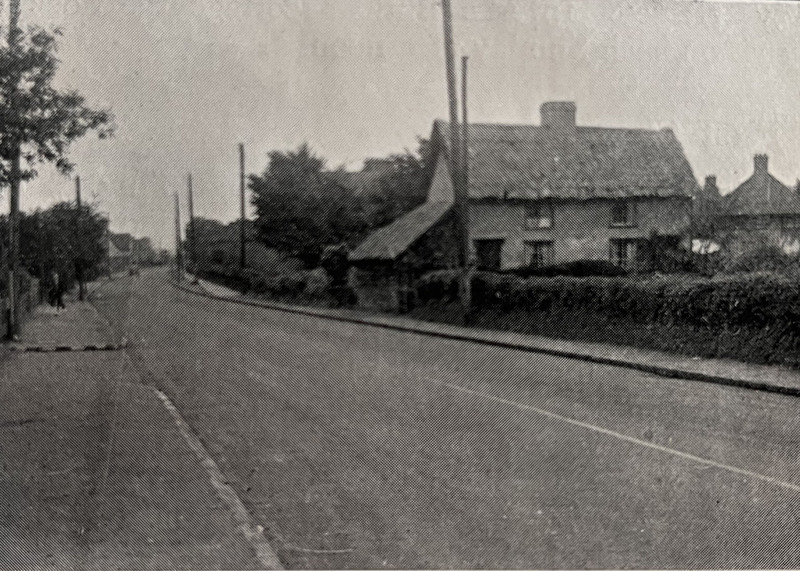
Mr. Butler’s Cottage, Corringham Road
The First Chapel
Those who gathered in the cottage Sunday by Sunday during the following sixteen years had a great ambition. They wished to build a chapel in the village.
In about 1850, Mr Allen, a baker, was erecting a rough cart shed in the Sandpits. It occurred to those early Methodists that the shed would be a suitable preaching place if it could be hired for the purpose. Those members of the society who were carpenters offered to construct a pulpit and forms, provided the use of the shed could be obtained.
Mr Allen was approached, and he quite reasonably wished to know for what purpose the shed was required. There was still, at this time, a strong prejudice against Methodism, and those who had approached him were, for this reason, hesitant in providing the information.
Eventually, however, they informed Mr Allen of their proposals, and to their amazement he cried:
“Why did you not speak before? We might have made something better of it. Perhaps, however, it is not too late.”
The baker immediately began the erection of a little brick chapel. The Methodists had to pay Mr Allen £21 in cash, and the building was leased to them for twenty-one years at a rental of £5 per annum.
After a Wednesday evening prayer meeting in Mr Massey’s house, it was suggested by Mr Butler that those present should inspect the new chapel, which was being erected nearby.
The friends gathered on the site and there held a short, informal service. Mr Butler led the gathering in prayer and asked God’s blessing upon Mr Allen for all his kindness. At the close of the prayer, a voice called out of the darkness:
“Thank you, Mr Butler, again and again.”
The tone of that voice told those present that it was Mr Allen himself, who had been watching the proceedings unobserved in the darkness. The small service ended with the singing of the Doxology, and in this manner the site of the new chapel was consecrated.
The chapel was opened on 17 April 1851, with the services on that occasion being conducted by the Rev. J. Hobkirk.
The building, which still stands in the Sandpits, had a gallery with interior stairs at the side and was arranged to seat 120 people. In more recent years, it has been put to secular uses, but although alterations have been made, one can still see carved on the outside walls the initials, presumably of those connected with the cause in those early days.
The chapel was in the Gravesend Circuit, and the Gravesend and Dartford ministers visited Stanford-le-Hope once a month. In addition, the services were taken by students and by lay preachers. Among the latter, many will remember Messrs G. Butler, W. Deed, W. Eve, W. Fordham, W. Hawkins, E. Reed, T. H. Sullings and W. Wrigglesworth, some of whom preached in the present church.
Before the coming of the railway to the village, the preachers who came from the Kent side of the river did so by rowing boat, afterwards walking to Stanford. Here they preached and dined, then walked to Linford for the afternoon service, and on to East Tilbury for the evening service. Through the darkness, they then returned to Tilbury, and from there crossed by rowing boat back to Gravesend.
Mr Butler became the first steward and class leader of the new Sandpits chapel. After his death in 1860, these offices were taken by Mr T. H. Sullings, one of whose sons was still resident in the village at the time this account was written.
Another Methodist of those early days was Mrs Elizabeth Hawkins, who did much for the cause, especially among the Sunday School children. She was the mother of the late Mr William Hawkins of Little Thurrock, who, until his recent death, was a lay preacher in the Circuit.
Mr Edward Reed will also be remembered by some. He was a tall, strong man, with a voice to match — a voice of thunder — and, as “Teddy”, became endeared to all who met him. He was a leader in the Sunday School and also gave much time to preaching, both in Essex and in Kent.
Mr Reed died on 15 April 1885, and the stone that stands to his memory in the parish churchyard was erected by voluntary subscription.
This brings us to another of those early workers, Mrs Margaret Massey, who is perhaps best remembered for her work in connection with the Tract Society.
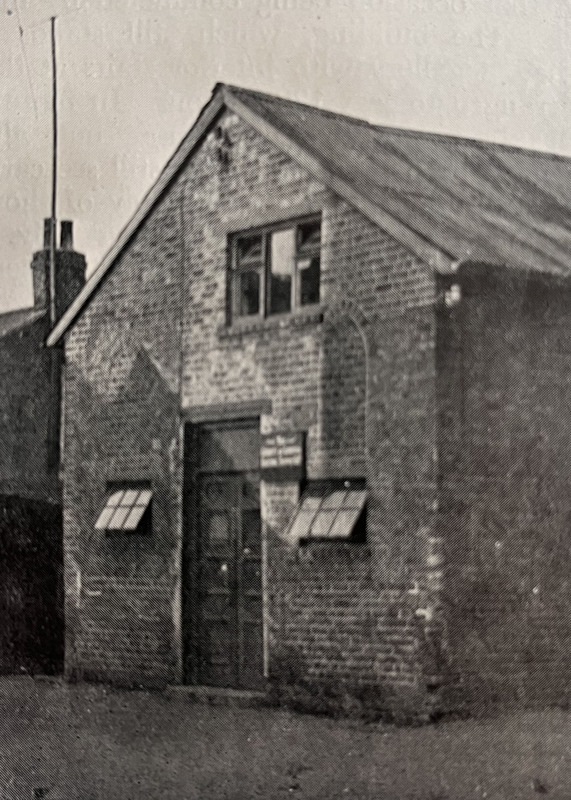
The Sandpits Chapel
The Tract Society
In 1850, Mrs Margaret Massey was, we are told, thinking over the lines:
“What shall I do to make it known
What Thou for all mankind hast done?”
Her heart was answered, and she undertook the work of tract distribution in the village, so that the villagers might, “through faith in Christ Jesus”, enjoy the same great blessings that she herself had experienced.
Such work could not be commenced without funds, but Mrs Massey obtained old tracts from the Dagenham Tract Society through the kindness of her brother, who was its superintendent. In this way, sufficient tracts were obtained for distribution to every house in the village, and for twelve months Mrs Massey carried on the work unaided.
Amid scorn and many discouragements, this heroine continued her service. As we look back, we see in her one who, despite such difficulties, was not afraid to do the will of her Master.
In passing, mention should be made of another great work carried on in this parish by Mrs Massey. At a time when the medical profession was not so well represented in the village as it is today, she attended to the needs of the people by healing and comforting the sick.
She had a considerable knowledge of the use of herbs in medicine, and used her ability with no small success. The service she was able to render to her patients was always “for the glory of God”, and the villagers received the treatment free of charge.
In 1851, she was joined in her work by Mr W. Payne and Mr T. H. Sullings, and the area of tract distribution was enlarged to include Horndon and Mucking.
In December 1852, a public tea meeting was held in the recently erected chapel in the Sandpits, and the proceeds of this function were devoted to the purchase of new tracts.
It is interesting to note that in 1853, when the number of workers had made it possible, Mr Payne extended his labours to Dry Street, “delivering the Truth to as dark and ignorant a people as could, we think, be found in England.”
The friends were soon joined by Mr W. Wrigglesworth, and the tract walks, as they were called, were extended to serve other villages. These included Horndon-on-the-Hill, Pump Street, Stanford village, Stanford Billet, Mr Eve’s cottages adjoining Oak Farm, Fobbing, Vange, Dry Street, Langdon Hills, Mucking village, Muckingford — now Linford — East Tilbury, Low Street, Orsett, Corringham, Orsett Heath, West Tilbury, Basildon, Thames Haven, Nevendon and Chadwell.
The Stanford-le-Hope Society was joined in 1856 by a similar group of workers at Tilbury, and some of the above walks were taken by them.
The records of the Society’s activities are brief, but the following extracts are worthy of note.
At a meeting held in the chapel on 28 September 1866, the members present were informed “that Brothers Nunn and Payne have been playing in a cricket match”, and it was thought that “this is an inconsistent mingling with the world.”
The secretary was instructed to convey this opinion to the brothers concerned, and at the next meeting submitted his report. This was received with satisfaction by all present, who recorded:
“…this meeting learns with pleasure that the cricket playing complained of was simply a practice with some few friends with some new bats they had made, and not, as was supposed, mingling with the ungodly in a regular cricket match.”
A meeting was held on 13 May 1868, and Brother Brown reported that:
“…the people he visits receive the tracts with kindness; likewise he feels convinced that some of the people are enquiring the way to Zion; the people that he visits who used to be about the street on a Sunday morning are now on a Sunday morning ready for chapel.”
At this same meeting, it is recorded that he felt “thankful to God that he is a distributor”, but that “he feels that he must give up on account that he suffers from rheumatics.”
The last meeting of this Society for which records have been found was held on 16 May 1870. It took place in the schoolroom beneath the present church, which had, at that time, recently been opened.
It is certain that the work of the Society continued for many years, but in 1889 it was being carried on by the Essex Mission, with which the Church was associated.
Mrs Massey died on 2 April 1879, and we must not leave this chapter without first recognising the important contribution she made to the cause.
The following men and women, many of whom were local preachers, were among those who laboured with Mrs Massey in her work:
Messrs J. Bridge, G. Butcher, H. Butcher, J. Catchpool, A. Ellis, W. Fordham, W. Hawkins, S. Kempster, W. Payne, J. Prayl, J. Rush, I. Sams, R. Schooling, T. H. Sullings and W. Wrigglesworth; Mesdames Aylott and Sullings; and Misses Massey, Massey, Nash, Nunn and Waters.
OUR PRESENT CHURCH
The Church
It was not long before those associated with the Sandpits Chapel found that a larger building would be required to provide for the ever-increasing congregation. The year 1870 marks the commencement of a new era in our story.
The site upon which our present church stands was given by Mr David Beckwith, who was a resident in the parish. The erection of the new building was placed in the hands of Mr T. H. Sullings, who had already served the cause and the Sandpits Chapel so well.
On 7 September 1869, the foundation stone was laid by Mr W. Eve, the lay preacher referred to elsewhere, who was the farmer at Oak Farm and one who took a particular interest in the Methodist cause in the village.
In the following year, the opening of the new church took place, and the services on that occasion were conducted by the Rev. Featherstone Kellatt.
The church, as originally erected, was similar in most respects to the building with which we are so well acquainted today. The schoolroom, however, had stairs at the sides, which gave direct access to the lobbies of the church, and the arrangement of the stairs up to the gallery has been altered in more recent years.
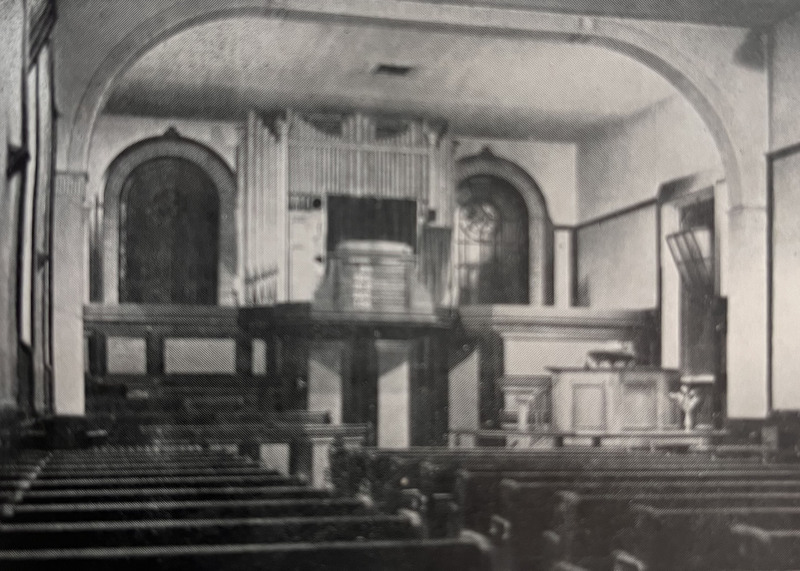
Most readers will remember the interior, with its long central pulpit and rostrum, its oil lamps, and behind these, the painted wall upon which were boldly written the Ten Commandments. Alterations and additions have since been made, but these are referred to later.
In passing, it is interesting to note that the iron windows which still give service at the sides of the church were brought from Barking Old Chapel and transported to Stanford-le-Hope in a wagon, making the journey by road.
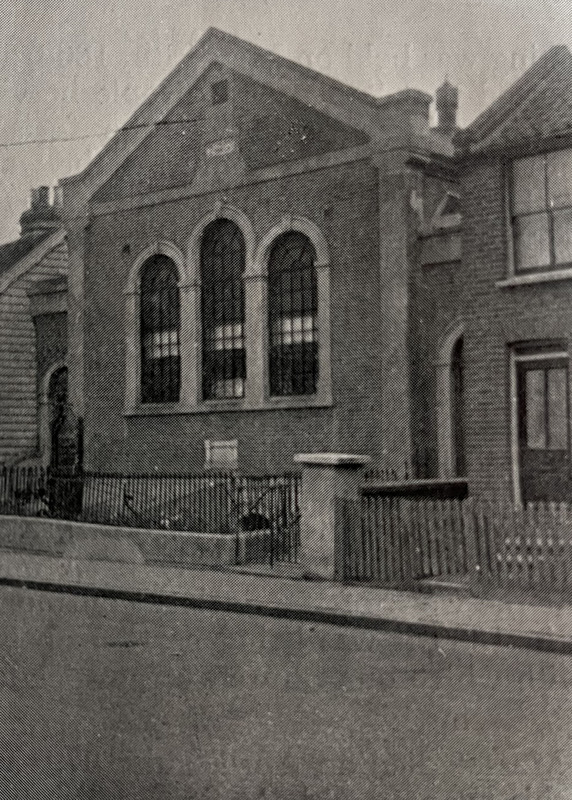
The Methodist Church, High Street
Our First Trustees
The new church was attached to the Essex Mission and was represented on the local Mission Committee, which met at Grays. This Committee was responsible for the finance and general organisation of the chapels within its district. It appointed lay agents and had complete charge of chapel property.
The representatives on the Committee were Mr A. Ellis, Mr G. Butcher and Mr T. H. Sullings, and these three are the first recorded “trustees” of the church.
The duties of the appointed lay agent appear to have been numerous. They included preaching, delivering tracts and visiting. His domain covered Tilbury Docks, West Tilbury, Horndon, Grays, Stanford-le-Hope, Little Thurrock, East Tilbury, Purfleet and Fobbing.
When we realise the difficulties of transport in those early days, we gain some idea of the size of his task.
The office seems to have been held first by Mr Pugh, followed by Mr Lany, who resigned the position in 1889. The Committee appointed Mr Pledger as his successor, at a salary of £80, with an additional £1 per quarter for travelling expenses. Mr Pledger had to reside at Stanford-le-Hope, and he lodged at what is now No. 9 The Sandpits.
The Committee was often financially embarrassed and time and again considered the advisability of dispensing with the services of the lay agent. It is pleasing to note, however, that the church was never in arrears with its grants to the Mission, which were £3 per quarter. This fine record must reflect great credit on the three representatives and the Stanford-le-Hope congregation.
At the close of the year 1892, Mr Pledger’s services were terminated, and the vacant position was advertised in the Methodist Recorder. Mr Wellock was appointed, and it is interesting that his ability to “lead the singing in some of the smaller places where there is no one equal to the task” was considered a most important qualification.
The position of lay agent was undoubtedly an arduous task, even without such additional responsibilities. It is fortunate for some of our less musically minded pastors that nowadays even our smallest village chapel has either a piano or harmonium.
The Grays Circuit
By 1895, the work on this side of the river had gained such importance that the Grays Circuit was created, and our own church became part of the new venture.
A Trust was elected, which conducted the local affairs of the Essex Mission. Reference must here be made to Mr L. E. Brand and Mr W. Payne, who were members of the Mission Committee.
Our First Minister
In 1895, following the formation of the Grays Circuit and the termination of the services of Mr Wellock, the Rev. W. Wakem Corin became the first minister.
He was succeeded in the following year by the Rev. Robert Rogers, who became a most popular man in the village. It was perhaps as well for Mr Rogers that the Tract Society had ceased its work, for he gained considerable distinction as a local footballer and started one of the first teams to play in the district.
In 1899, the Manse in Corringham Road was built, and its first tenant was the Rev. F. M. Halstead, who succeeded Mr Rogers as minister. Three years later, Mr Halstead was followed by the Rev. R. H. Gush.
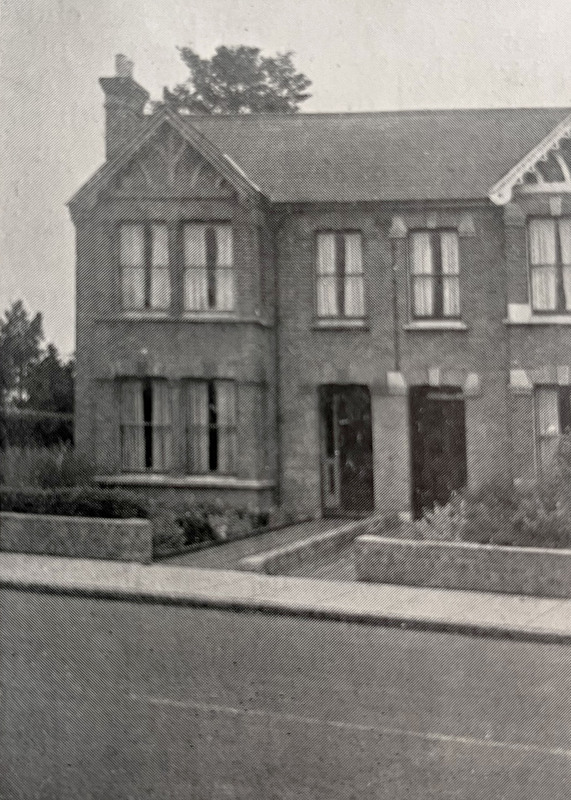
The Manse, Corringham Road
The Present Century
Prior to 1905, many of the mid-week gatherings, such as sewing meetings and meetings of the Trustees, were held in the small cottage, now used as a store, which stands near the south wall of the church. This cottage was hired by the church for that purpose, but in 1905 the Trustees decided to discontinue its use.
In the same year, the cottage on the north side of the church, together with adjacent land, was purchased at a cost of £160, and the building has since been occupied by the church caretaker.
About this time, a new heating plant was installed in the church, the schoolroom was renovated and some drainage works were carried out. These works were necessary due to the fact that the schoolroom had been requisitioned by Essex County Council for use as a day school.
In 1907, during the ministry of the Rev. A. Wilks, the church adopted the use of the new Wesleyan hymn book, which had first been published six years earlier. The old hymn books were distributed to the Horndon, Linford and Fobbing chapels.
As far back as 1910, the Trustees considered the advisability of extending the church and even discussed the possibility of erecting a new building. It was decided to extend, and land at the rear of the church was purchased with this in view.
Various extension plans were prepared at this time, and the proposals were under constant consideration, but it was not until 1923 that the extensions were carried out.
In 1911, gas lighting was installed to replace the oil lamps which had given service for the past forty years.
The Great War was responsible for a period of comparative inactivity in the affairs of the church, but in 1920, the Jubilee year, an effort was made to start an extension and organ fund. A Summer Bazaar was organised, and £254 was raised for the new venture.
During the next two years, more funds were obtained, bringing the total to £529. It was then resolved to proceed with the extension scheme. Tenders were received, and the works were carried out in 1923 at a cost of £1,935 5s.
While these improvements were taking place, services were held in the schoolroom. On 21 November 1923, the reopening services were conducted.
The next aim of the church became the provision of an organ. By September 1928, the installation of the instrument had been completed at a cost of £400, plus £65 for the necessary alterations to the building.
The following year was the sixtieth anniversary of the erection of the church, and on 6 November 1929, the Rev. I. G. Goldhawk, of Kingsway Hall, visited, making it a red-letter day in this story.
In 1932, alterations costing £330 were carried out in the schoolroom. These included the substitution of steel joists and stanchions for the old timber beams and pillars, and the installation of electric lighting. In the following year, electric lighting was also installed in the church.
Since the enlarging of the church in 1923, two anniversaries had been observed each year: one at Whitsun, which was the birthday of the 1870 opening, and the other in November. In 1934, however, it was decided that the Whitsun anniversary should be discontinued.
The reunion of Methodism, which brought about the fusion of the Primitive, United and Wesleyan Methodists, took place in 1932, and the church then became part of this new Union. A revised hymn book was published and adopted for use in services at Stanford-le-Hope in 1934.
During the five years preceding the Second World War, the church pressed steadily onwards, making continued efforts in the face of ever-increasing difficulties. Church attendance, as far as the adult population of the country was concerned, was becoming less than perhaps at any other time in the church’s history. To make matters worse, many members of the church left the district for business reasons.
Looking back on those few years immediately before the Second World War, however, it is interesting to note the successes attending the cause in the town. Two matters stand out and are certainly worthy of special mention.
In the first case, we delight in the spirit which prevailed between ourselves and our friends who worshipped at the Parish Church. Good feeling and high regard, one for the other, had for many years characterised the congregations of both churches. The last decade had witnessed the growth of a friendship and mutual esteem greater even than in the past.
It was fitting, therefore, that in 1939, when the six bells in the tower of the Parish Church were recast and two additional bells added, one should bear the inscription:
“To the Glory of God and an expression of the Unity in Devotion to our Lord and Master Jesus Christ, from the Methodist Church in this Parish.”
Another outstanding feature of those pre-war years was the success which attended the work among the children in the Sunday School. Sincerity and enthusiasm are essential for those undertaking such service, and the important part played by the School in the affairs of the church reflects great credit on all concerned.
The Second World War
On 3 September 1939, our country declared war upon Germany, and the next six years were destined to be a time of severe trial for the inhabitants of the town.
Most readers will recall that morning service on Sunday 3 September 1939, when, within a few minutes of war being declared, the sirens sounded. Thus early did the conditions of war impinge upon the normal activities of church life, and very soon unusual difficulties presented themselves.
Evening services were held in the afternoons because of the dangers of blackout conditions, and other major problems soon became apparent. Many of the young people had to leave the district to undertake work of national importance, and ninety-two answered the call to the Services.
Of these, it was inevitable that some would be called upon to make the supreme sacrifice. We honour them, and their names are especially recorded elsewhere in this volume. It is for us to ensure that the ideals for which they died will become the foundations of a far happier future for mankind.
It was with regret that, at the end of 1943, we learned that Mr Evelyn Key, a pilot in the R.A.F., was reported missing on operations.
Mention should also be made of four other young members who were held as prisoners of war. We assure them of our gratitude and our great pleasure at their safe return:
- Mr Harry Beasant — Italy, 1943–45
- Mr Edgar Biggs — Germany, 1941–45
- Mr Charles Levett — Japan, 1942–45
- Mr John Rhead — Germany, 1940–45
In 1940, an air-raid shelter was erected adjoining the schoolroom, and the schoolroom itself was offered to the authorities as accommodation for people rendered homeless by air-raid activity.
The schoolroom thus became a “front-line” Rest Centre, and at one period as many as fifty homeless people were provided with food and shelter on the premises. Their stay lasted three weeks, and the preparation of meals and attendance upon the unfortunate guests placed heavy demands upon the church workers who had volunteered for the task.
On other occasions, too, people from surrounding districts who had been rendered homeless by bombing found temporary shelter on the premises.
In January 1941, a Church Youth Club was organised and became one of the first clubs of its kind in the country. The members of this club, realising the need for Sunday evening services despite the blackout, arranged services of song, which were held in the schoolroom and received warm support from those who could leave their homes under the extremely trying conditions.
Church membership is now approximately 185, and during the war some thirty to forty new members have been accepted into the Church. During the last six years, serving men and women stationed in or near the town have been especially welcomed to services, and numerous church parades have taken place.
While preparing this story for the printers, we have been cheered to hear the good news that, under the preaching of the “Christian Commandos” and the resident minister, a goodly number of youths and girls have consecrated their lives to Christ during the past weeks.
A “Junior Commando” team has been formed, and the team’s purpose is to visit the surrounding villages with the message of God’s redeeming love.
Such difficult times as those through which we have so recently passed made great demands upon our minister. In closing this chapter of the story, reference must be made to the splendid work of the Rev. and Mrs G. H. Morris.
In addition to their normal duties, they freely ministered to a people often distracted and perplexed by events which had shaken the civilised world. They maintained constant contact with members in the Forces, and frequent visits were paid to local military camps.
Their ministry in the town commenced in 1936, and there are none who will not regret the fact that they are to leave the district during the coming year. During their ministry here, they both became endeared to all with whom they came into contact.
It is, in no small measure, due to their sincere and patient enthusiasm that the church has meant so much in the life of the town during the last ten years.
We wish them well in the years to come and consider ourselves fortunate to have shared their ministry here at Stanford-le-Hope.
Ministers Since 1895
- Rev. W. Wakem Corin — 1895–1896
- Rev. Robert Rogers — 1896–1899
- Rev. Frederick M. Halstead — 1899–1902
- Rev. Robert H. Gush — 1902–1903
- Rev. John Billington — 1903–1906
- Rev. Arthur H. Wilks — 1906–1909
- Rev. Herbert E. Hopper — 1909–1912
- Rev. J. Howard Weir — 1912–1915
- Rev. J. Magill — 1915–1917
- Rev. E. Harris — 1917–1920
- Rev. W. B. Butters — 1920–1922
- Rev. William A. Beckett — 1922–1925
- Rev. George H. Simpson — 1925–1929
- Rev. Ernest H. Lawrence — 1929–1932
- Rev. Percy E. Bannister — 1932–1933
- Rev. J. Russell Pope — 1932–1933
- Rev. C. Cathay Marris — 1933–1936
- Rev. G. Hireson Morris — 1936–
The Church Trustees
In 1899, the Church Trustees, who had been elected following the formation of the Grays Circuit, were:
Mr L. E. Brand Sen., Mr J. Brown, Mr H. Butcher, Mr G. W. Cooke, Mr W. Deed Sen., Mr W. T. Deed, Mr E. Deeks, Mr A. Ellis, Mr J. Green, Mr G. C. Hammond, Mr C. H. Jennings, Mr W. E. Mott, Mr W. Payne Sen., Mr W. I. Payne, Mr T. H. Sullings Sen., Mr J. M. Sullings and Mr T. H. Sullings.
The Trust was reformed in 1911 as follows:
Mr L. E. Brand, Mr T. Brown, Mr H. Butcher, Mr G. W. Cooke, Mr W. Deed Sen., Mr W. T. Deed, Mr J. Dobson, Mr A. Ellis, Mr C. W. Hawkins Sen., Mr W. Levett, Mr W. E. Mott, Mr D. E. Partridge Sen., Mr C. W. Smith, Mr T. H. Sullings Sen. and Mr J. M. Sullings.
A further change was made in 1921, and the Trust then consisted of:
Mr A. E. Ager, Mr L. E. Brand Sen., Mr J. M. Brand, Mr H. Butcher, Mr W. T. Deed Sen., Mr A. W. Deed, Mr J. Dobson, Mr W. A. Ellis, Mr E. T. Ellis, Mr I. Hammond, Mr C. W. Hawkins Sen., Mr C. W. Hawkins, Mr T. G. Hawkins, Mr W. Levett, Mr W. E. Mott, Mr E. Partridge, Mr G. Rayner, Mr J. M. Sullings and Mr C. L. Webster.
The present Trust was constituted in 1934, and those who were made responsible for the maintenance and safekeeping of the church were:
Mr I. Anker, Mr A. Arrowsmith, Mr F. G. Beard, Mr K. Brabyn, Mr J. M. Brand, Mr G. S. Brough, Mr N. W. Burrough, Mr W. T. Deed, Mr J. Dobson, Mr G. E. Drinkall, Mr W. A. Ellis, Mr F. Hall, Mr C. W. Hawkins, Mr J. A. Heretage, Mr G. Key, Mr H. Knight, Mr O. Massey, Mr E. Partridge, Mr W. Pentelow, Mr G. Rayner, Mr A. E. Reeves and Mr R. Webster.
As most readers will know, this Trust is now greatly depleted. Many have left the district, but let us here pay tribute to the memory of those who have so recently been taken from us.
We think of Mr G. S. Brough and Mr G. E. Drinkall, who both passed away in 1935; also Mr I. Anker, Mr W. T. Deed and Mr J. Dobson, who were taken from us during 1939. We also honour the memory of those members of former Trusts who, during the last few years, have passed on to their reward.
The long and close association of all these men and their families with the church will be remembered for many years to come. It is hoped that this little book will, in some way, help to perpetuate their names and the names of all those who have done so much for the church through the years.
The Choir
The time of the formation of the first choir is uncertain, but at the beginning of the present century, the singing in the church was ably led by a choir of about thirty voices, with Miss Dexter as leader.
At that time, the choir was seated in the gallery, but later occupied the two front corners of the church, on either side of the central pulpit. This arrangement continued until the extension of 1923, when the present choir stalls were constructed.
During the past years, the choir has been well supported and has given admirable service to the church. Concerts have been arranged, and in this way funds have been raised towards the cost of the many improvements undertaken.
The present choir is now about thirty voices strong, and we cannot but admire the loyal way in which the members lead the service of song Sunday by Sunday.
Choir Leaders
- Mr Curnow — 1904–1912
- Mr Smith — 1912–1914
- Mr A. Deed — 1914–1929
- Mrs C. W. Hawkins — 1929–1935
- Mr J. Pike — 1935–1936
- Mr R. A. Luscombe — 1936–1939
- Mr Stoakley — 1941–1942
- Miss Ciceley Goodwin, acting — 1942–1944
- Mrs N. Burrough — 1944–
The Organ
The first organist of whom there appears to be any record was Mr Swift, who played the harmonium in the present church soon after its opening in 1870.
He was succeeded in about 1880 by Mr T. H. Sullings, who was assisted, when he first took the position, by his brother, Mr S. J. Sullings. It is somewhat amusing to learn that one played the treble stave, while the other provided the bass chords which completed the ensemble.
Soon, however, Mr T. H. Sullings had to carry on unaided, and many will remember how, when occupying the pulpit, Mr “Teddy” Reed would, after announcing the hymn, call:
“Play up, Tommy.”
And so the music would begin.
Prior to 1928, music was provided by an American organ, which was at first in the gallery and later in the front of the church, close to the pulpit.
In 1928, during the ministry of the Rev. G. H. Simpson, the present organ was installed. At the opening, a recital was given by Mr Allan Brown, A.R.C.O., then of Kingsway Hall, and later of The Dome, Brighton.
The organ is a two-manual instrument, complete with pedal organ, and was made and installed by Messrs Henry Speechley and Sons of London. The organ has a light oak case and forms an outstanding feature of the interior of the church.
Organ Specification
Great Organ
- Open Diapason — 8 feet
- Clarabella — 8 feet
- Salicet — 4 feet
Swell Organ
- Violin Diapason — 8 feet
- Lieblich Gedact — 8 feet
- Gemshorn — 4 feet
Pedal Organ
- Bourdon — 16 feet
- Bass Flute — 8 feet
Couplers
- Swell to Great
- Swell to Pedals
- Great to Pedals
- Swell Octave
The instrument is at present blown by hand, but as electricity is now available in the church, it is to be hoped that an electric blower will be installed in the very near future.
Organists
- Mr T. H. Sullings — about 1880–1906
- Miss K. Brand — 1906–1907
- Miss E. Butcher — 1907–1911
- Miss K. Brand — 1911
- Miss N. Dobson — 1911–1912
- Miss W. Deed — 1912–1924
- Mr F. Amos — 1924–1926
- Mrs Massey and Mrs Ellis — 1926–1927
- Mr C. Burton and Miss E. Lazell — 1927–1936
- Mr R. A. Luscombe — 1936–1939
- Mr F. G. Beard — 1939–1940
- Miss J. M. Maxwell — 1940–1941
- Mr A. Stoakley — 1941–1945
- Miss C. Goodwin, acting — 1942–1945
- Miss C. Goodwin — 1945–
Rev. Stephen John Sullings
During the many years that have contributed to the history of the church, countless good men have been called to serve among us as lay preachers. Many of these, too numerous to mention, have been members of our own congregation.
It may not be known, however, by all those who read these pages, that at least one Wesleyan Methodist minister ordained by Conference received his early call while associated with this church.
He was a member of a family to whom we owe much for our early progress, and he will be remembered by many of our present members. His name was Stephen John Sullings, and he was the son of Mr T. H. Sullings, who played such an important part in the affairs of Methodism in this district during the latter half of the last century.
Born in 1868, he had visions of the ministry while quite young, but in 1888, at the age of twenty, was rejected by the Conference.
In the book God Guided Me, he says of this time:
“I was only a village lad, and I had learned to believe in God with my whole heart. At the family altar, from early childhood, I had heard my father pray to God as a man may talk with his friend. In the week-night prayer meetings I was accustomed to hear men and women, many of whom could neither read nor write, wrestle with a real Deity for the blessings of salvation, and to see them fight with weapons not carnal against a real Prince of the Power of Darkness till they had won the victory.”
He continued:
“Again and again in recent years had I seen the little, plain, unpretentious vestry beneath the chapel full of agricultural labourers and other horny-handed sons of toil, together with their women folk, upon whose tear-stained, radiant faces the light of heaven shone right gloriously as they lustily sang:
‘I’ll sing with the glittering crown on my brow:
If ever I loved Thee, if ever I loved Thee,
If ever I loved Thee, my Jesus, ’tis now,’
or some similar song. In such an environment, naturally enough, my faith in God was both simple and strong.”
The “unpretentious vestry” was none other than our own schoolroom.
Mr Sullings was soon after this called to go to Australia, where he became a student at Queen’s College, Melbourne. In 1892, he became a minister in Australia and, for nine years, served under the Victoria Conference.
Nine years later, he was accepted by the Conference in this country and was appointed to the Sussex Mission, where he served for three years. This was followed by similar terms in the South London Mission, Hull, Burnley and Norwich.
In 1915, the Rev. S. J. Sullings was made a full-time chaplain with the 54th East Anglian Division and was sent to Gallipoli. There he contracted enteric fever and, after being brought home to this country, died on 16 November 1915 in the Military Hospital in Birmingham.
Thus, the Rev. S. J. Sullings passed on to his reward at the early age of 47, leaving behind numerous souls in this country and Australia, won for the Master whom he had served so well.
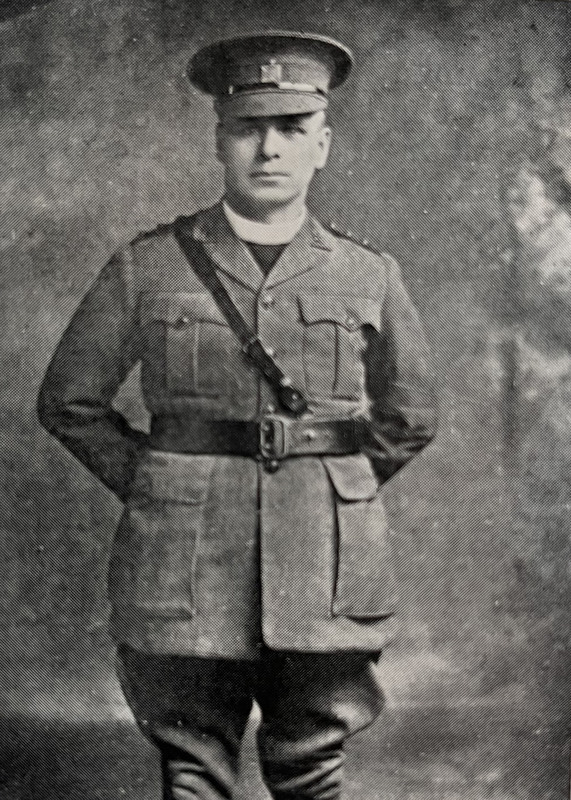
Rev. S. J. Sullings
The Sunday School
From the beginning, the church has taken particular interest in the welfare of its young people, and a Sunday School has always been part of its work.
As early as 1852, the children were taught by members of the Tract Society, either in their homes or in the Sandpits Chapel. By about 1880, a regular school was conducted by Mrs Hawkins and later by Mr W. Deed.
The latter’s son, the late Mr W. T. Deed, carried on his father’s work. It is, in no small measure, due to these and other ardent workers that we have such a fine School today.
The present Sunday School, of which we may feel justly proud, is divided into three sections:
- Primary Department — for children up to the age of nine years
- Intermediate Department — for scholars from nine to twelve years of age
- Senior Department — for those aged twelve and over
The membership of these in 1939 was 57, 108 and 52 respectively. The staff of the school at present numbers 30, under the leadership of Mr K. Brabyn, and a more loyal and devoted group of workers could nowhere be found.
The Primary Department celebrates its twenty-first anniversary during 1946, and we extend to the children and staff our heartiest congratulations and good wishes for the future.
The school has, it seems, always enjoyed a summer treat, and this has taken many forms. In about 1885, the children were taken for a trip on the Thames in a barge provided by Mr A. Ellis. Later, a summer treat was held in a field at Oak Farm, while in 1900 the children were entertained at Butts Farm, which was in London Road.
Since that time, the treat has been held at Horndon and in the meadow on the west side of Park Road.
How different were these occasions from those that take place today. In more recent years, prior to the war, the children were taken to the Zoo, Epping Forest, Maldon, Felixstowe and Walton-on-the-Naze. The outings became so well attended by children and their friends that thirteen coaches were required for conveyance.
Now that hostilities have ceased, it is to be hoped that these happy events will once again be possible.
It was inevitable that the coming of the war in 1939 would make itself felt in the Sunday School. The temporary absence of staff and the difficulty of ministering to the children under “front-line” conditions made the task of the remaining Sunday School officers almost impossible.
It reflects great credit, however, on all concerned when we learn that not a single service of the school was cancelled, and that membership figures today are:
- Primary Department — 55
- Intermediate and Senior Departments — 138
It may be of interest to recall that, on one occasion when an air raid was in progress, the school service was interrupted and the children were told to stamp their feet and clap their hands to the rhythm of the hymn “Onward, Christian Soldiers”. This was done so that the little ones would not hear the noise of heavy gunfire greeting the invading aircraft.
It is our business to ensure, in so far as we are able, that such events will never occur again, and in this task we shall need the efforts of thinking men and women everywhere.
The anniversary of the school is held in June and takes the form of special Sunday and Monday services. At these services, the children take a most active part, and their singing of the anthems and hymns is outstanding and a joy to all who hear them.
The author feels that this chapter would be incomplete unless record was made of the names of some of those who have laboured so loyally among the children during the past years. They are:
- Mrs E. Hawkins — Superintendent
- Mr E. Reed
- Mr W. Deed Sen.
- Mr W. T. Deed
- Mr C. L. Webster
- Mr A. E. Ager
- Mr G. Ashley
- Mr A. Heritage
- Mr W. Rounce — Teacher
- Mrs B. J. Beard
- Miss M. Partridge
- Miss M. Levett
Social and Other Activities
Perhaps the earliest weekly social events to be arranged by the church were the Pleasant Saturday Evenings, carried on under the leadership of Mr Pledger in about 1890.
They were held in the schoolroom, which was, we are told, always well filled for such occasions. Those who were able provided the entertainment with songs, violin and concertina solos, and a good time was had by all.
In more recent times, since 1922, boys’ and girls’ clubs have been organised, and their weekly meetings have provided games and other similar entertainments for the young people associated with the church.
It has been a feature of these clubs that each year the members present concerts, and the high standards of performance attained have made them outstanding events in the social side of church work. Special mention should here be made of the Passion Plays presented at Eastertide during recent years by the members of the Senior Girls’ Club.
For many years, a Church Guild has functioned successfully and contributed much to the achievements of Methodism in the district. The Guild was, according to available records, formed in 1905 and, with the exception of the war years, has continued its work since that time.
Prior to 1905, weekly class meetings were held in the schoolroom, but the devotional section of the Guild has since met this need. In more recent years, not only devotional, but educational and recreational evenings have been provided for members throughout the winter.
It is to be hoped that the weekly meetings of this section of the church will soon be resumed.
The Church Youth Club, founded in 1941 and already referred to, is now a most active organisation with a membership of approximately 80. During the war years, from 1939 to 1945, the club arranged weekly social evenings for serving men and women stationed in the district, and its members take an active part in church affairs.
As is the case with most Nonconformist churches, the continuation of the work is entirely dependent upon the free giving of church members. There are times when special efforts are made to raise funds for specific purposes.
To this end, bazaars have been organised, and during the difficult years of 1939 to 1944 alone, some £800 was raised.
In 1942, the church was honoured when the present Queen sent to the bazaar a silver casket, the sale of which assisted in obtaining the funds required.
In social affairs, too, the Sunday School has played no small part. Arts and crafts exhibitions have been held, and these have proved to be most interesting occasions.
A most active tennis club has, since 1927, formed an important section of the church’s social functions. The tennis courts in London Road have contributed in no small measure to the happiness of church members, and it is to be hoped that, with the return of peace, the club will flourish as never before.
The temperance cause has constantly found a place in the work of the church, and its first Temperance Society was formed in 1867. This proved to be a most flourishing organisation, with a committee consisting of church members.
A Band of Hope was provided for the young people, while, in addition, those associated with the Society organised a band, which played in the village and district and took part at the functions of the Society.
The Band of Hope was largely composed of the Sunday School children, and these two sections of church work were closely attached.
The Stanford-le-Hope Temperance Society became defunct about 1900, but several Bands of Hope have since been organised for the junior members of the church.
On 8 August 1935, some of our friends were granted a Charter of the International Order of Good Templars, and many of the church members became workers in the Lodge. Under circumstances which made the continuation of their functions impossible, the Lodge was disbanded in 1939.
Among the many other activities associated with the church, mention should be made of the annual Christmas Carol Party. Even during the last six years, these enthusiastic friends have ventured out into the darkened streets, proclaiming their message in song.
The National Children’s Home and Orphanage has benefited financially through their efforts year by year, and it is to be hoped that they will continue their good work.
Wartime has certainly provided them with strange experiences, and they have had to contend with wailing sirens, gunfire and the noises associated with aerial warfare, punctuated by hurried retreats into a nearby ditch or hedgerow as some missile hurtled too close for personal comfort.
That cup of coffee provided on the doorstep by some sympathetic church member at the close of the evening was certainly well deserved.